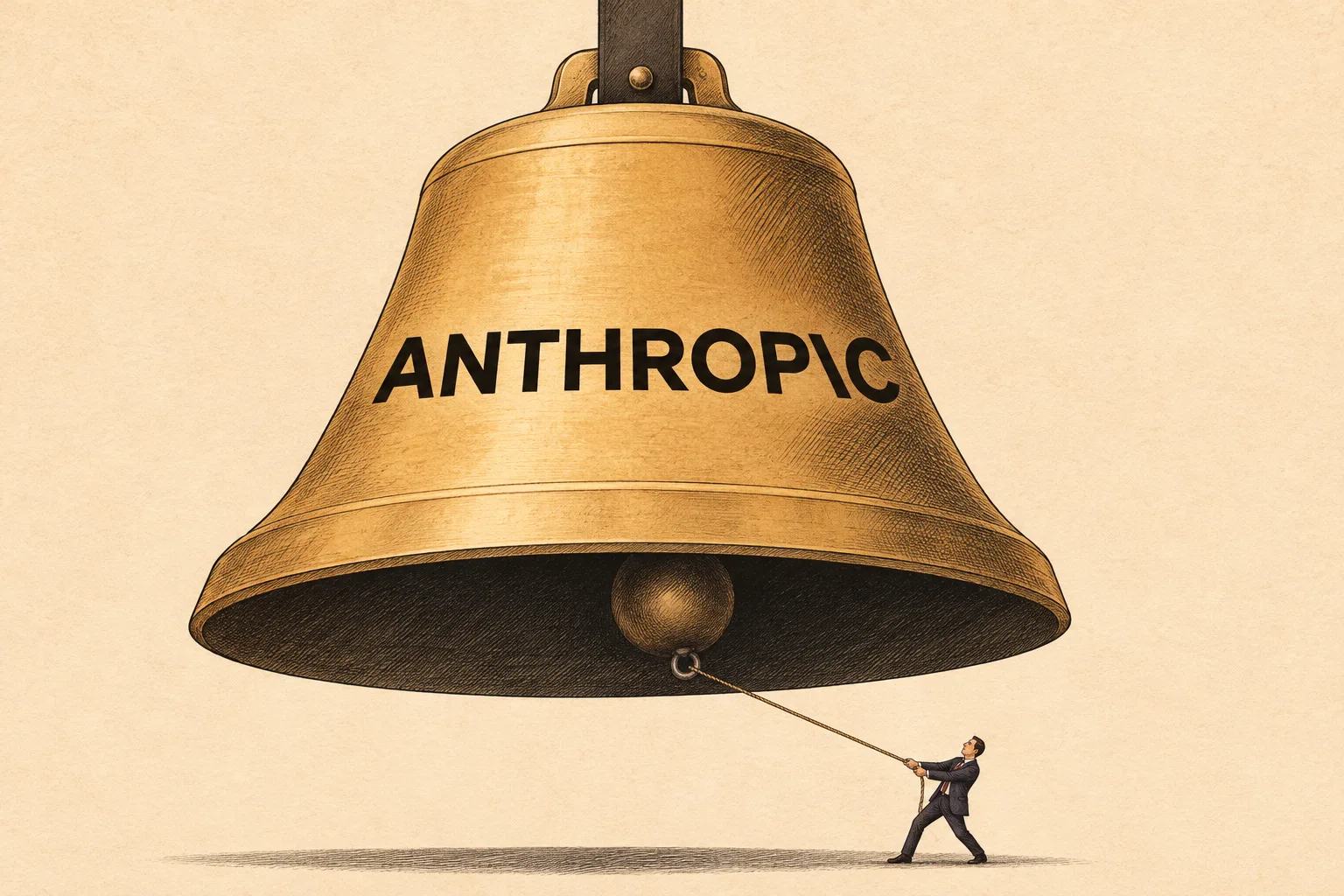
Anthropic goes public today at a valuation of $1.5 trillion. It has surpassed SpaceX and has the biggest IPO in history

The company behind Claude AI sold shares for $83 each and raised $81 billion. Trading begins today. Its revenue is growing twelvefold, but it was profitable for just one quarter.
Key points
Anthropic sold $81 billion worth of shares, securing the biggest stock-market debut in history.
Investor demand exceeded the offering six to seven times over.
The company's revenue in the latest quarter jumped 1,127 percent year over year.
The first operating profit in the company's history lasted just three months.
Anthropic has committed to spending approximately $900 billion on computing power.
Wall Street has been waiting for this day all year. Anthropic $ANT, the company that develops Claude AI, announced the final price of its shares on Wednesday evening: $83 each. Trading is set to begin on the Nasdaq stock exchange in New York this afternoon, our time.
It's the biggest initial public offering (IPO) of all time. The company sold 980 million shares, and investors paid roughly $81 billion for them. The previous record had been held since June by Elon Musk's SpaceX $SPCX, with $75 billion.
At this price, Anthropic as a whole is worth around $1.5 trillion. The five-year-old company will immediately rank among the world's most valuable companies on its first day.
More shares than planned, and at a higher price
Just a week ago, the plan looked more modest. When Anthropic launched its offering to investors, it was aiming for 825 million shares at $70 to $78 each. But according to reports, demand exceeded supply six to seven times over, so the company raised both the price and the number of shares.
The banks organizing the offering can also buy an additional 147 million shares within thirty days. Separately, there's a private sale worth another $26 billion, in which the main buyers are chip and cloud providers led by Alphabet $GOOG and Nvidia $NVDA .
The timing is remarkable, too. Tech stocks have had a nervous few days following the unexpected departure of Nvidia chief Jensen Huang, yet investors paid more for Anthropic shares than the company had originally asked.
Retail investors received an unusually large allocation. The company reserved as much as a fifth of the offering for them, compared with the 5 to 10 percent typically allocated to retail investors in major US offerings. Those who didn't get an allocation at $83 can buy shares on the stock exchange starting today, at a price set by the first trades.
Revenue the stock market has never seen
The figures the company disclosed in its prospectus show why demand for the shares is so strong. In the third quarter, it brought in $17 billion, up 1,127 percent year over year. Revenue for the first nine months of the year topped $33 billion.
Arun Sundararajan, an economist at New York University's NYU Stern, remarked that he couldn't find a comparable example in history of a company succeeding so quickly.
Anthropic doesn't make most of its money from individual subscriptions. Roughly four-fifths of its revenue comes from businesses paying based on how much work Claude actually does. It has more than 11,900 customers who spend over $100,000 a year. About 250 of them pay more than $10 million.
At a valuation of $1.5 trillion, however, investors are paying roughly 22 times annual revenue, if we annualize the latest quarter. That's a price that assumes growth won't slow for a long time.
“A strong first day and a strong long-term investment are two different things.”
Matt Frankel, analyst at The Motley Fool
Profit lasted three months
A weaker point in the story lies a few lines lower. In the second quarter, Anthropic reported an operating profit for the first time in its history. Three months later, it was back in the red.
Q2 2026 | Q3 2026 | |
|---|---|---|
Revenue | $11.6 billion | $17.0 billion |
Computing costs | $5.6 billion | $9.9 billion |
Operating result | $974 million profit | $567 million loss |
The reason is simple. Demand for Claude is growing faster than the company can secure data-center capacity in advance. So it had to buy computing power at short notice for $5 billion, at a much higher price than under long-term contracts. Another $2 billion was taken up by a one-time accounting expense.
Shortly before these figures were released, analyst Jay Goldberg of Seaport Research Partners warned that the profit would last a quarter or two at most before the company returned to losses. It happened even faster.
“This is definitely a pretty challenging starting point for their IPO.”
Jay Goldberg, analyst at Seaport Research Partners
A $900 billion bill
An even bigger number concerns the future. Anthropic is contractually committed to spending approximately $900 billion over the coming years, almost all of it on computing power and data centers. It is due to pay around $70 billion in the next twelve months alone, and roughly half the total by the end of 2030.
For comparison, at the end of September the company had about $132 billion in cash and short-term investments. So the money from today's offering isn't a cushion for harder times. It's there to pay bills the company has already signed up for.
The whole bet rests on a simple premise. If revenue keeps growing at its current pace, the commitments will pay for themselves, and cheaper long-term contracts will gradually replace expensive last-minute purchases. If growth slows, the bills will stay the same.
What history says about the first day
The remaining question is how the stock will perform after the opening bell. The statistics point to a sharp start. Jay Ritter, a professor at the University of Florida who has studied IPOs for decades, calculated that US IPOs priced above their original range rose by an average of 50 percent on the first day.
But Ritter has another figure, too. Shares of newly listed companies returned an average of about 6 percent in their first year, while similarly large established companies returned around 11 percent. And all twelve of the biggest US IPOs since 2008 fell below their first-trade price at some point during their first year.
SpaceX offers a recent example. Its IPO price was $135, its first trade was at $150, and the stock then spent many weeks below that level.
“An IPO is the opening statement, but the real evidence will come from earnings.”
Robert Schein, chief investment officer at Blanke Schein Wealth Management
There's another mechanism at play, too. Today, only a small fraction of the company is trading, roughly one-twentieth. Approximately 15.5 billion shares are held by employees and early investors, who generally can't sell them for at least 180 days; founders must wait a year. Only when those lockups expire will we see what price the market assigns to Anthropic when far more shares are available for sale than there are today.