$NVDA: revenue +103%

$NVDA: revenue +103%, but I'm not buying more for now. Why?
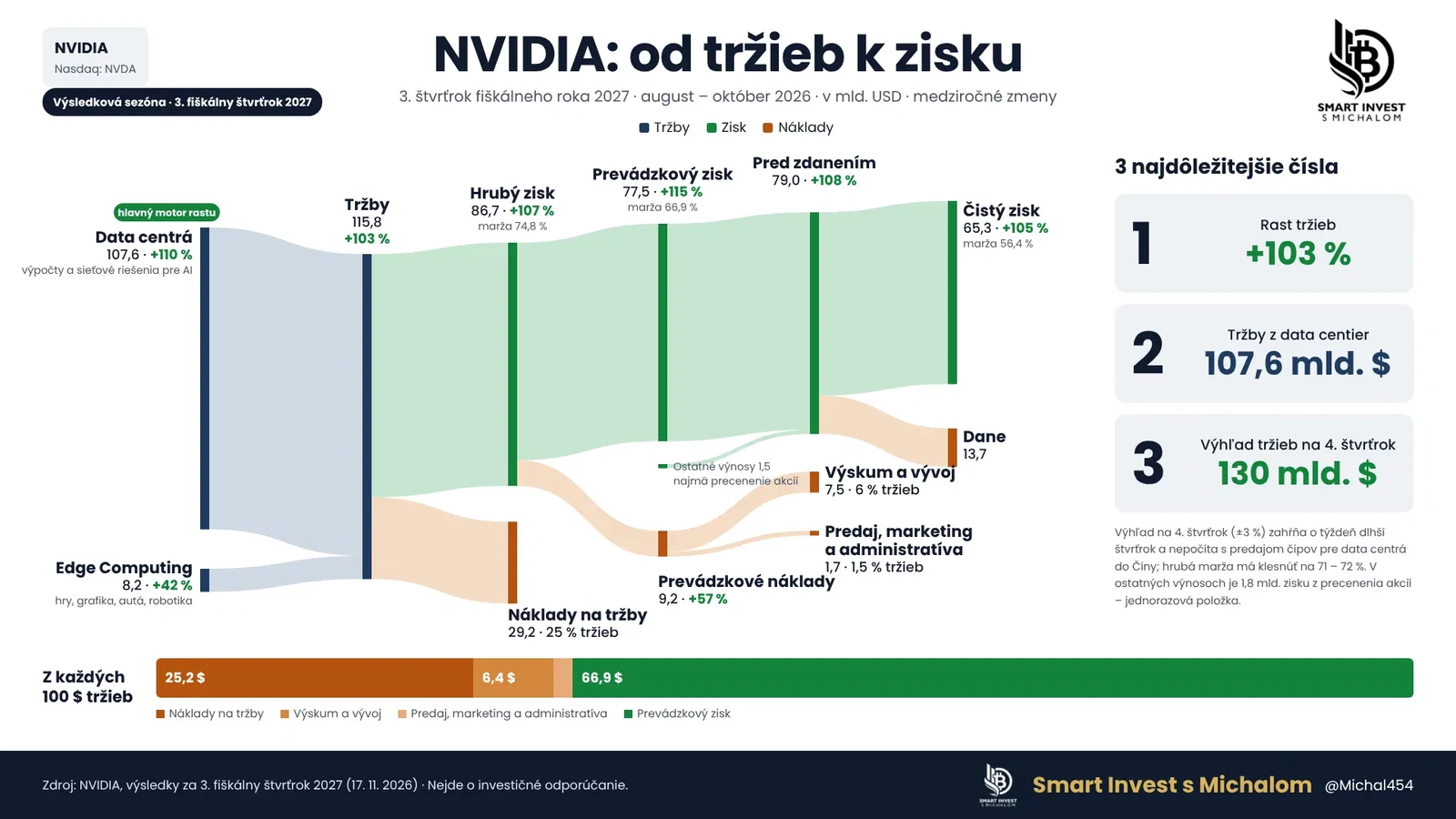
NVIDIA has once again shown how strong a business it has built. Revenue for the 3rd quarter of fiscal year 2027 reached $115.8 billion, up 103% year over year. Adjusted earnings per share rose 111% to $2.68, and revenue guidance for the next quarter is $130 billion ±3%.
Even so, I don't feel the need to increase my position right now. What interests me most is how NVIDIA will operate without the person who set its direction for years.
📊 WHAT THE NUMBERS SAY
• Data centers brought in $107.6 billion, up 110% year over year.
• Net income reached $65.3 billion, up 105% year over year.
• Adjusted gross margin was 74.9%.
• Gross margin is expected to fall to 71 – 72% next quarter.
By my calculation, data centers account for approximately 93% of revenue. So demand for AI infrastructure is clearly reflected in the results. But the outlook should also take into account that the next quarter will be one week longer, and the company is not expecting revenue from computing chips for data centers in China.
From the perspective of the current business, these are excellent results. But they don't yet answer the question that interests me most today.
🧠 JENSEN WAS A VISIONARY FOR THE COMPANY, IN MY VIEW
I saw Jensen Huang as someone who could spot opportunities years in advance and build an entire company around them. To me, he wasn't just a CEO overseeing the company's financial performance.
Colette Kress, who is leading the company temporarily, has spent many years as its CFO. I saw them as a pair who complemented each other well: Jensen brought big plans, while the financial leadership was meant to ensure the company could afford to carry them out.
Now, though, I want to see who will set the company's future technological direction. Financial experience and many years at the company are advantages, but on their own they don't prove that someone can replace the founder's vision as well.
At the same time, it would be premature to say that all the company's ability to innovate left with Jensen. NVIDIA has other people who have developed its products. The question is how this team will operate and make decisions without him.
⏳ THESE RESULTS WERE STILL TAKING SHAPE UNDER JENSEN
The reported quarter ended on October 25, before his departure. That's why I don't see this report as proof that the new leadership has managed the transition.
Future quarters may also benefit from products, relationships, and plans that took shape during his tenure. The real difference may only emerge gradually, when decisions have to be made about the next generation of products and new investments.
That's why I'll be watching more than revenue growth. I'm interested in who they choose as permanent CEO, what direction they set out, and whether the company can continue doing what made it such a strong player.
🤝 AN INTERESTING DETAIL ABOUT TRUST WITH TSMC
In an interview with Lex Fridman, Jensen said that over decades they had done an enormous amount of business with TSMC and had no contract. He was talking about trust between the companies. He also mentioned his close relationship with TSMC founder Morris Chang.
I wouldn't conclude from his words that there is no legal documentation between the companies. But they do illustrate the importance he placed on personal trust and relationships built over many years.
That's exactly why I'm interested in how these relationships will carry over to the new leadership. His departure doesn't automatically mean losing partners, but I also don't want to assume that absolutely nothing will change.
🔍 HOW I'M APPROACHING THIS
I have a direct position in $NVDA of approximately 0.6% of my portfolio, with an average purchase price of $124.16. I have additional exposure through a Nasdaq ETF, so NVIDIA has a larger weighting in my portfolio than the direct position alone suggests.
I see the area around $150 as a technical level worth watching. For me, though, the price level alone doesn't outweigh the uncertainty around the company's future leadership.
I'd consider buying more in the $100 – $120 range. I don't consider it certain that the price will reach that level, and it may never get there at all. Even in this range, I wouldn't buy automatically if the decline were accompanied by a deterioration in the business.
When I say it's “50-50” for me right now, I mean uncertainty, not a calculated probability. On the one hand, I see an excellent business; on the other, I don't know what its leadership and direction will look like several years from now.
Another unknown is the circumstances of his departure and any further findings. I didn't get enough answers from the earnings call to get clarity on this. As ordinary investors, we only see part of the information, and we shouldn't make up the rest.
So I'm holding my position and will wait for the next few quarters. I'd rather accept that buying more may end up costing more than increase my position now just because the stock has fallen.
This is my personal view, not investment advice; the value of an investment can go up or down, there is a risk of loss of capital, and past performance is no guarantee of future results.
Stocks mentioned